
 ไทย
 中文 (中国)
 日本語


The forehead is another feature many people care a great deal about. It is closely tied to the rest of the face, and a face that is balanced with the forehead looks softer and more graceful. Everyone’s forehead shape is different: wide, narrow, high, flat, prominent or with a receding hairline, depending on genetics, ethnicity or sex. For people whose forehead is flat, lacks dimension, is out of proportion or unbalanced, there are now many ways to make the forehead look softer and better suited to the face, such as hairline waxing, forehead injections, forehead augmentation, or make-up to correct flaws around the forehead. But some of these methods may not really address the problem. At SLC Hospital we offer forehead reduction surgery, which can correct a wide forehead, a high forehead, a narrow forehead or a receding hairline, also known as an M-shaped hairline. In some people the forehead looks so high that they appear to be balding. These problems can be corrected with forehead reduction, which addresses them directly and gives very satisfying results. It can also help correct droopy eyes, making the eyes look fresh again, and reduce wrinkles on the forehead.
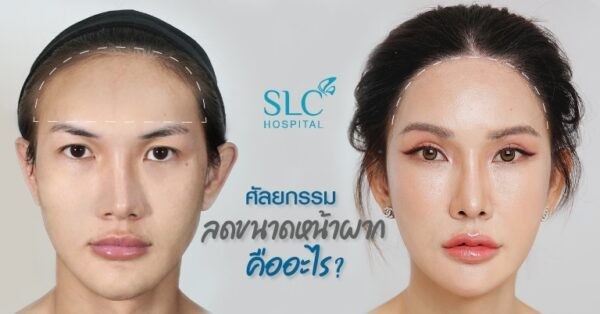
What is forehead reduction surgery?
It is designing a forehead shape to suit each person’s facial structure. The surgeon makes an incision along the hairline and pulls the scalp forward to correct a wide, high or narrow forehead or a receding hairline, giving it a beautiful shape. Where the forehead is too wide and too high, the hairline may sit higher than normal, making the person look bald and the face out of proportion. Forehead reduction can correct this without the need for a hair transplant, and also adjusts the position of the hairline to suit the face and look more complete.
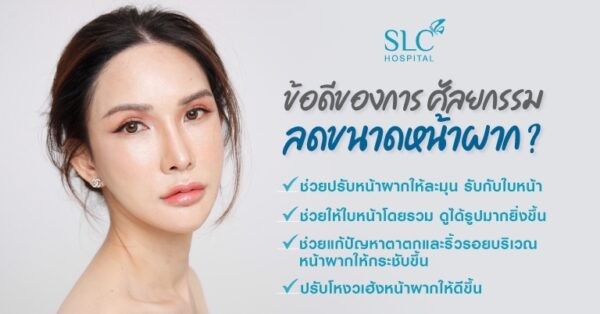
Benefits of forehead reduction
- Makes the forehead softer and better suited to the face
- Makes the face look slimmer and smaller without facial contouring surgery
- Helps correct droopy eyes and tightens wrinkles on the forehead
- Improves the forehead’s physiognomy (face reading)
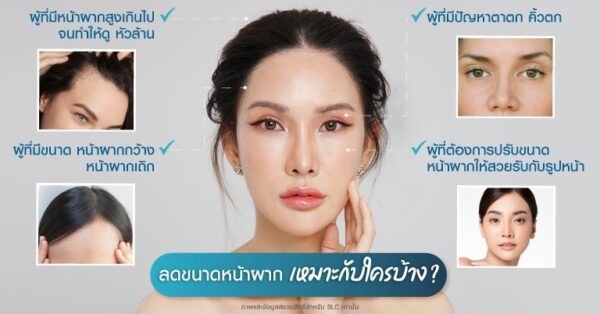
Who is forehead reduction suitable for?
- People with droopy eyes or droopy brows
- People with a wide forehead, a narrow forehead or a receding hairline
- People whose forehead is so high that they look bald
- People who want to resize their forehead to suit their face shape
Causes of a high or wide forehead
- Genetics inherited from family or relatives
- Stress
- Hormonal imbalances in the body
- Everyday habits and behaviour
- Side effects of certain medications
Benefits of forehead reduction surgery at SLC Hospital
- Specialist surgeons experienced in facial surgery, with individual assessment and design
- A cosmetic surgery hospital with rooms meeting Thai Boutique Hospital standards
- Modern operating room technology
- 1:1 anaesthesiologist care under general anaesthesia
- Equipment to prevent blood clots in general anaesthesia cases
- 1:1 registered nurse care, 24 hours a day
- Personal Patient Advisor, your own personal surgery consultant
- Excellent service, with care and follow-up after forehead reduction surgery
- Trusted by SLC patients and well regarded among international patients
Preparing for forehead reduction surgery
- Tell us your health information, such as underlying conditions and drug allergies
- Stop smoking and drinking alcohol at least 2 weeks before surgery
- Stop aspirin-type medicines, vitamins and supplements such as fish oil at least 2 weeks before surgery
- Wash your hair thoroughly before the day of surgery, and do not wear make-up on the day of surgery
- Do not wear clothing with electrically conductive metal; wear front-buttoning clothes so they are easy to put on after surgery
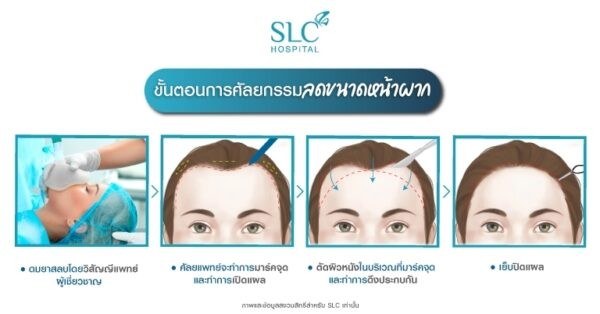
Forehead reduction steps
- Arrive 1 hour before your surgery time to prepare
- On arrival, the patient registers with the hospital, has their blood pressure checked and takes painkillers and antibiotics
- Discuss the shape with the doctor; the surgeon assesses and analyses the shape and size that suit you
- A specialist anaesthesiologist administers general anaesthesia
- The surgeon makes the incision as assessed to be suitable
- The skin assessed by the surgeon is removed, and the skin is pulled down about 1.5-2 centimetres, making the forehead look narrower and the face better proportioned
Treatment time
- Surgery takes about 1–2 hours ( depending on the individual )
Aftercare following forehead reduction surgery
- Relieve pain with painkillers as prescribed by your doctor
- Apply cold compresses for swelling
- Clean the wound as your doctor instructs
- Keep the incision dry at all times; do not let it get wet until the stitches are removed
- Have the stitches removed at the appointment your doctor gives you
- Follow your doctor’s advice strictly
- Swelling and bruising may occur after surgery, especially in the first 1-2 weeks, and will steadily improve over 3-4 months
- Avoid drinking alcohol and smoking
- Avoid seafood, pickled and fermented foods, spicy food and food that is hard to chew during the first month
- If you notice anything abnormal, come in for a consultation right away
Q&A Frequently asked questions about forehead reduction
Q: Does forehead reduction hurt?
A: Forehead reduction surgery at SLC Hospital is performed under general anaesthesia by an anaesthesiologist, so you feel no pain during the operation.
Q: How do forehead augmentation and forehead injections differ from forehead reduction?
A: Forehead augmentation and forehead injections fill the forehead and add dimension to it, whereas forehead reduction is surgery to correct various forehead problems so the face looks more balanced.
Q: For droopy eyes and forehead wrinkles, which is better: forehead reduction surgery or a lift with Endotine?
A: For people with droopy eyes and forehead wrinkles, forehead reduction surgery can lift the eyes so they look brighter, reduce forehead wrinkles and adjust the forehead structure to suit the face better. Endotine devices can also correct droopy eyes and forehead wrinkles, but for people whose forehead is already too wide and too high, using Endotine will make the forehead even wider. Whichever method is used also depends on the surgeon’s assessment.